Why the market stopped funding promising projects, and started demanding prepared companies
The investment market is going through a quiet, yet profound transition. The abundance of good ideas contrasts with the scarcity of truly structured companies. Innovative startups keep emerging, founders keep building relevant solutions, but capital has become more selective, more technical, and far less tolerant of improvisation.
This is not a shortage of resources.
It is a rise in standards.
Over more than two decades working with business structuring, governance, and the expansion of companies in Brazil and abroad, I’ve closely followed the evolution of investor behavior. What used to be driven mainly by growth potential and innovation is now supported by organizational maturity, predictability, and execution capacity.
Today, investors don’t evaluate only what a company promises to deliver. They evaluate whether it can sustain its own growth without compromising value, control, and governance.
The first element they look for is the founder’s real command of the business. It’s not enough to understand the product or the market. Investors assess whether the entrepreneur understands operational, legal, and financial risks, recognizes the limits of the current structure, and can make decisions based on data and scenarios, not only enthusiasm.
Another central aspect is organization before expansion. Rapid growth is no longer an unquestionable sign of efficiency. Growth without structure has become a red flag. Companies that scale without clear processes, minimum governance, and organized financial flow tend to burn cash inefficiently, create hidden liabilities, and damage valuation in the medium term.
How risk is handled also weighs decisively. Every business involves risk. The difference lies in awareness and risk management. A clear corporate structure, well defined contracts, compliance, financial controls, and strategic planning signal maturity. The absence of these elements signals improvisation and fragility.
Investors also observe the founder’s relationship with control and power. Scalable businesses require delegation, discipline, and transparency. Entrepreneurs who centralize decisions, resist processes, and view governance as a threat often face invisible limits to growth. Not because they lack talent, but because they lack structure.
Long term vision has become another determining factor. Startups and companies don’t fail only due to lack of capital. They fail because decisions are made as if the future were predictable and linear. Strategic planning is not excessive caution. It is maturity in the face of complexity.
Perhaps the most sensitive point is the one few say out loud, not every company is prepared for its own success. When the structure cannot support growth, fundraising, or internationalization, success stops being an opportunity and becomes a risk. Investors perceive this mismatch quickly, even when they choose silence.
That’s why investors rarely say everything they observe. When they ask hard questions, they usually already know the answers. Many decisions are made before the meeting even ends.
What founders need to adjust to access capital in the current scenario
The market is not closed to investment.
It is more demanding.
Companies seeking capital must understand that structure is no longer a differentiator, it has become a basic requirement. Minimum governance, corporate organization, clear contracts, and structured financial flow are no longer nice to have. They are entry conditions.
Founders must demonstrate risk awareness. Investors don’t expect uncertainty free businesses, but they do expect entrepreneurs who can map risks, prioritize them, and manage them responsibly.
Planning must come before expansion. Grow first, structure later is no longer acceptable. Structure needs to keep up with, or anticipate, growth.
Governance must be understood as a strategic ally. Resistance to processes, controls, and transparency is interpreted as operational weakness and management risk.
Finally, it’s essential to show that the company can sustain its own success. Fundraising, scale, and internationalization only create value when the foundation is prepared to absorb complexity without losing control, credibility, or efficiency.
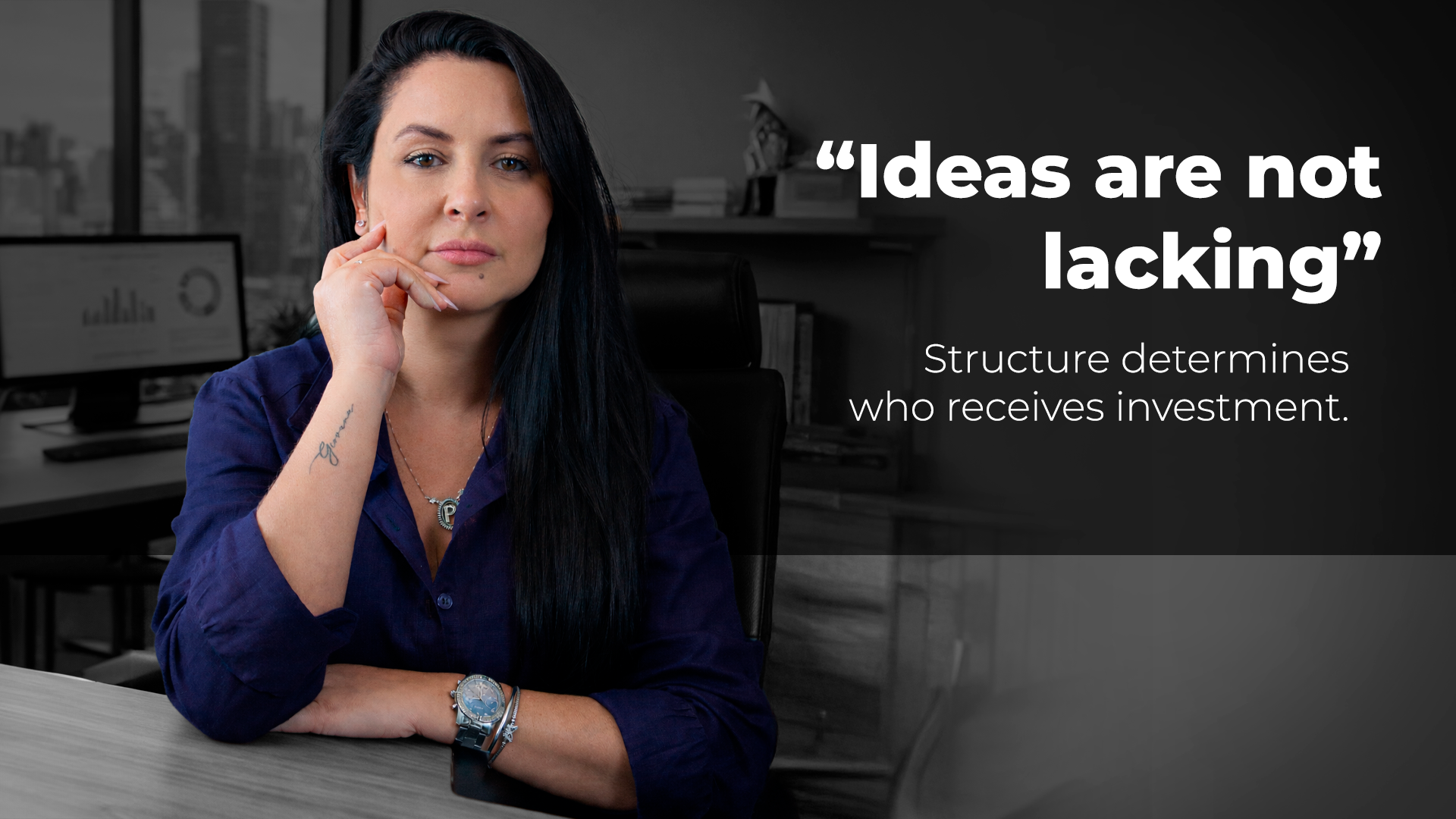
In today’s market, ideas still matter.
But it’s structure that determines who gets investment.
Priscila Campos
CEO
Specialist in Business Structuring, Governance, and International Expansion
Strategic work alongside entrepreneurs, startups, and investors to build structures capable of sustaining real growth and long term decision making.