
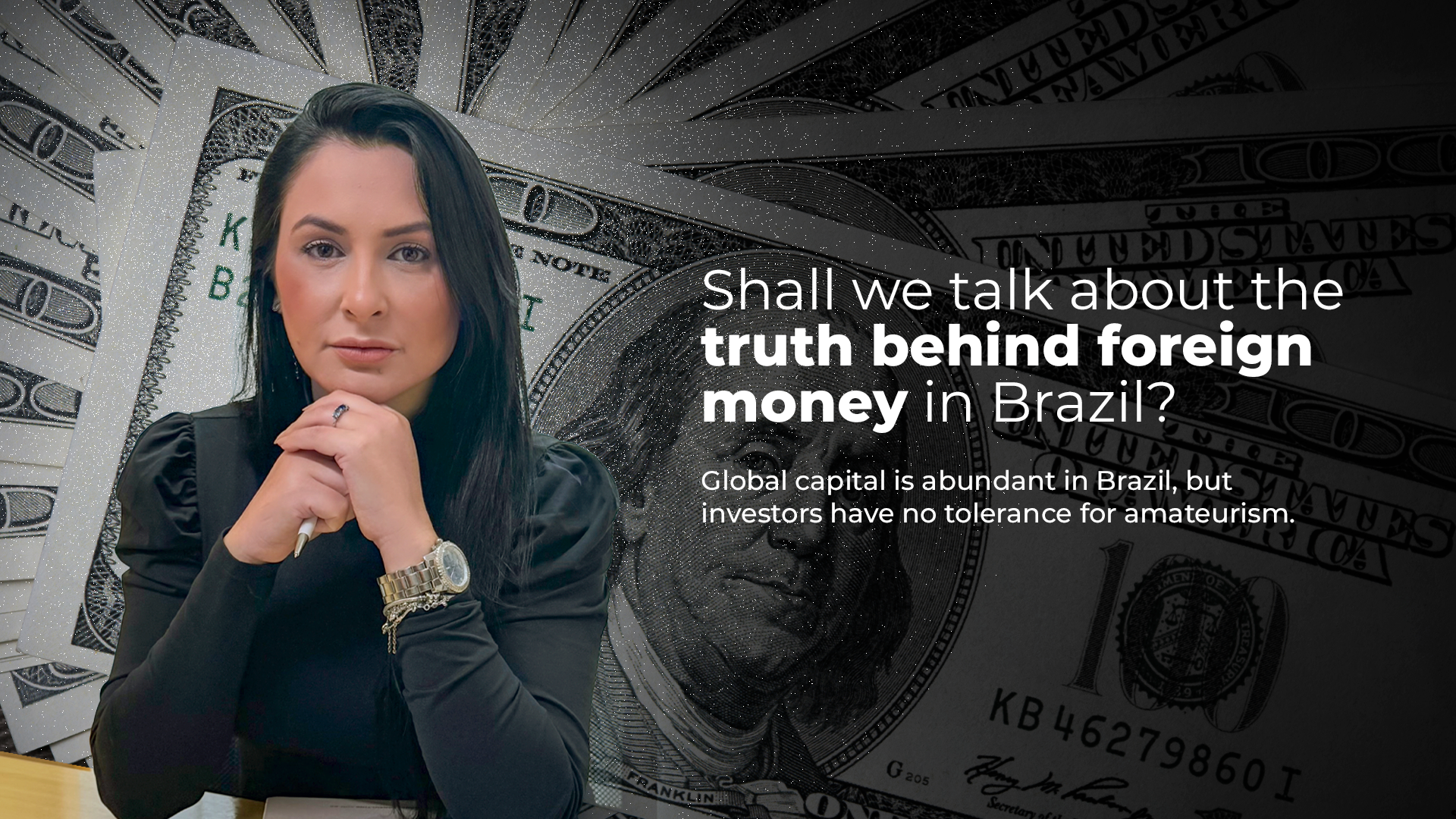
If you lead a fast-growing company or are seeking traction to scale your startup in today’s environment, your daily focus probably revolves around two words that dictate survival in the market: scale and capital.
In today’s business ecosystem, Brazil stands out as one of the most fertile and promising territories for attracting global productive capital. Official reports continuously released by the Central Bank clearly confirm this reality. Foreign Direct Investment flows move tens of billions of dollars every year, revealing an immense pool of international liquidity actively searching for real and innovative assets within the country.
However, let’s speak candidly, executive to executive.
If one of these major international investment funds expressed interest in injecting millions of dollars into your business today, would your internal structure truly be prepared to withstand the deep and relentless due diligence process required before they sign a check?
Many founders, directors, and brilliant entrepreneurs genuinely believe that the secret to closing a successful funding round lies in the genius of the product or the beauty of the pitch deck.
But the reality of the boardrooms where major investments are decided shows exactly the opposite.
Strategic capital wants growth, disruption, and innovation.
But it has zero tolerance for administrative and regulatory amateurism.
In the chessboard of global finance, the seriousness of your management is not merely a desirable characteristic. It is a direct risk indicator that influences the price of your valuation.
Institutional capital does not buy a good idea. It buys sustainability.
In my daily work serving on boards of directors and acting as legal representative for major global corporations across dozens of countries, I see the same story repeated over and over.
The foreign investor bringing long-term productive capital is not making a casual bet. They are not gambling on an emerging market.
They enter an operation to build real value, strong governance, and long-term sustainability for their own shareholders.
This means that the first team sent by a European or North American fund to analyze your business will not be marketing professionals or sales executives.
The first delegation arriving at your company will consist of lawyers, accountants, auditors, compliance professionals, and risk management specialists.
When these analysts open the structural records of an organization and find confusing accounting practices, lack of transparency in tax planning, or a decision-making model entirely centralized around the founder, the negotiation often ends immediately.
For international investors, legal certainty and regulatory clarity matter far more than the optimistic revenue projections displayed in a business plan.
Administrative integrity becomes the only real guarantee that their capital will not disappear into the complexities of the Brazilian environment.
How governance increases valuation and accelerates startup traction
Many entrepreneurs and startup founders still view regulatory compliance as an annoying obstacle, an unnecessary burden, or a bureaucratic cost center that consumes resources better allocated to product development.
But implementing corporate governance best practices from the earliest stages of growth is not about slowing a company down.
It is about creating speed with security and predictability.
When your company demonstrates clear processes, strong data protection practices, and fully auditable accounting, the perceived risk for international investors immediately declines.
In the corporate chess game, lower perceived risk translates into two critical advantages:
Access to cheaper capital.
And a significantly higher valuation during fundraising rounds.
Professionalizing management and creating an effective advisory board early in the company’s development become some of the strongest arguments when presenting the business to foreign investors.
It demonstrates that leadership possesses the strategic resilience necessary to guide the organization through any global economic volatility.
It shows the market that despite being a young or expanding company, you already understand how large international corporations operate.
The invisible cost of distrust
When an organization fails to demonstrate institutional strength, the price imposed by investors can be devastating.
In the best-case scenario, investors demand such a substantial discount for the perceived risk that the transaction no longer makes sense for existing shareholders.
In the worst-case scenario, they simply walk away and invest in your nearest competitor.
This is what the market calls the cost of distrust.
For Brazilian companies to continue growing and accelerating national productivity, leadership teams must urgently change their mindset.
Governance is not a performance designed to impress foreign audiences.
Compliance is not an isolated department created solely to approve contracts.
They are powerful tools for business acceleration, asset protection, and international capital attraction.
Reaching the next level requires daily corporate diplomacy.
It means sitting at the table with foreign investors, understanding their regulatory concerns, and possessing the internal technical capability to protect Brazilian operations from local legal and tax complexities.
When this bridge of mutual credibility is established, capital flows naturally and uninterrupted.
Economic growth stops being an abstract projection in a report and becomes reality within the company’s cash flow.
Credibility is the only asset that accepts no shortcuts
The significant investment flows continuously recorded by the Central Bank prove one thing beyond any doubt:
There is an ocean of opportunities waiting for well-structured companies in Brazil.
However, the selection process for those resources is becoming increasingly rigorous, analytical, and selective.
Global investors have abundant capital.
What they do not have is time or patience for companies that neglect transparency or attempt shortcuts in data validation.
Building a company capable of attracting major international funds requires technical consistency, rigorous accountability, and a flawless long-term vision from its shareholders and leadership.
The rewards of this institutional strength quickly become visible through strategic partnerships, access to advanced technologies, and the financial muscle necessary to dominate a market segment.
At the end of the day, credibility is the only global currency that preserves its value regardless of local currency fluctuations or geopolitical crises.
If your startup or company builds this foundation from the beginning, attracting international partners and major funding rounds ceases to be a distant dream.
It simply becomes the next logical step in your growth journey.
How has your company prepared its internal structures and processes to attract and provide full legal security to major investors in today’s market?
Priscila Campos
CEO of Grupo International