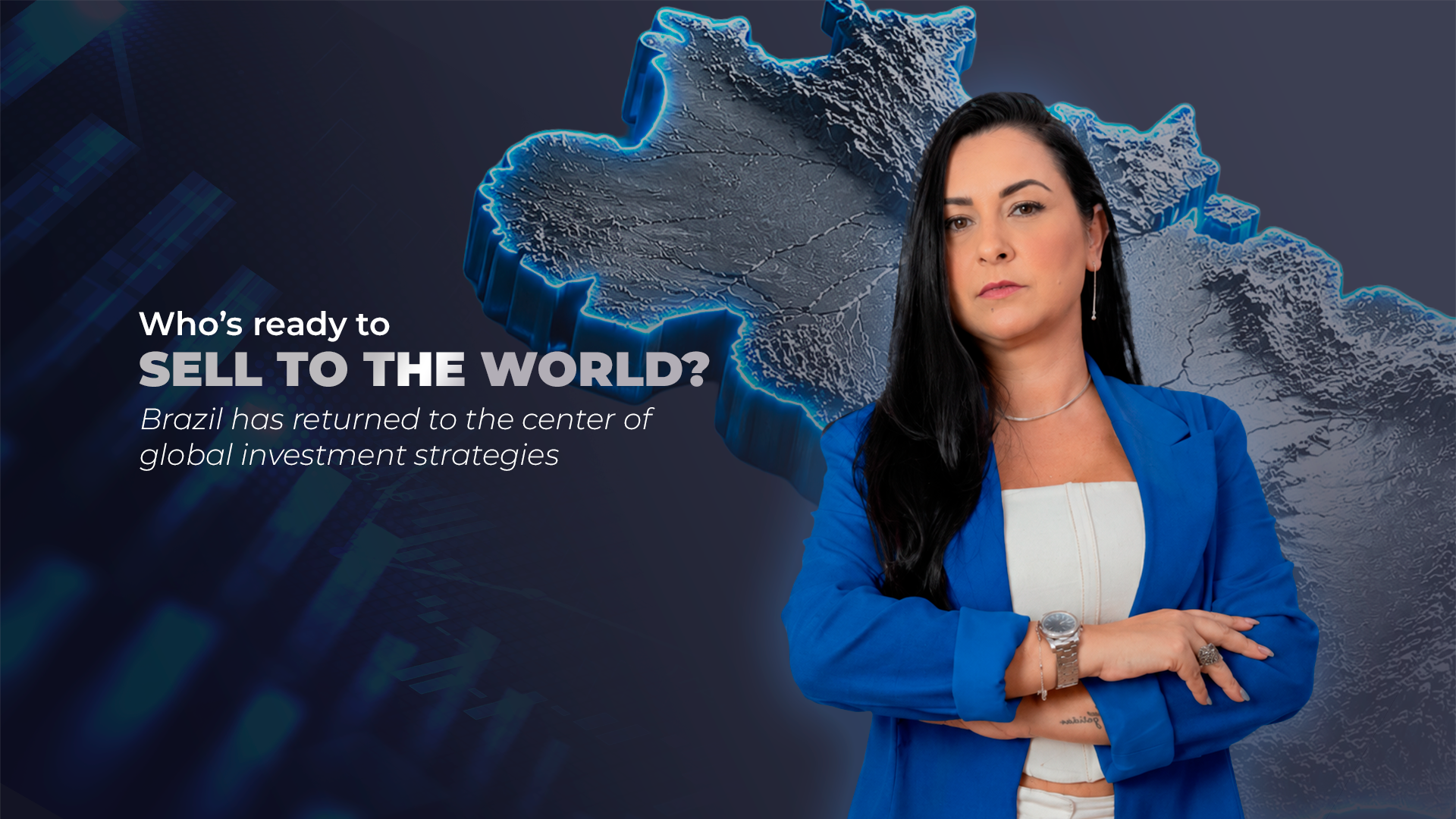
The advance of foreign capital into the country is no longer merely a financial movement. What is happening now is a strategic repositioning of global assets toward countries with productive capacity, energy security, agricultural strength, and geopolitical relevance. And Brazil is at the center of this movement.
By Priscila Campos
A silent transformation is taking place in the global economy.
While part of the Brazilian market still focuses only on political volatility, high interest rates, and exchange-rate fluctuations, international investors have begun to view Brazil from a much more strategic and structural perspective.
This is not just about economic growth.
This is not just about emerging markets.
What is happening now is a global reorganization of capital in search of assets considered essential for the coming decades, including:
- Clean energy
- Food security
- Critical minerals
- Infrastructure
- Agribusiness
- Technology applied to production
- Carbon
- Logistics
- Exports
- Natural resources
Few countries can simultaneously combine all these factors as Brazil does.
And recent numbers help explain why the country has returned to the radar of major global investment decisions.
According to data released by the Central Bank of Brazil, foreign direct investment in Brazil ended 2025 at levels considered among the most significant of the last decade, reinforcing the country’s position among the world’s main destinations for productive capital.
Recent data from the Central Bank itself shows that direct investment flows continue to strongly support Brazil’s external accounts, demonstrating structural confidence from international investors even amid a highly volatile global scenario.
At the same time, international analyses from the OECD indicate that Brazil occupies a strategic position within the new global economic reorganization driven by nearshoring, the search for more resilient supply chains, and the growing need for energy and food security.
The international market is changing rapidly.
And this transformation favors countries capable of producing, exporting, and sustaining long-term operations.
Global capital has begun to seek predictability, structure, and real assets
For many years, foreign investors analyzed Brazil mainly through the lens of domestic consumption potential and population growth.
Today, the logic is far more sophisticated.
Large international groups have begun prioritizing countries capable of offering strategic assets associated with the new global economy.
This explains the recent advance of international investments linked to renewable energy, strategic mining, agribusiness, logistics infrastructure, and technology applied to production.
According to a recent Reuters report, Brazil has assumed a prominent global position in attracting Chinese investment, surpassing historically relevant economies and consolidating itself as one of the main international destinations for capital linked to clean energy, mining, and the automotive industry.
This data is extremely relevant.
Because it demonstrates that Brazil is no longer viewed merely as a regional market.
The country has begun occupying a strategic position within global productive expansion chains.
And there is a very clear reason for this.
The world is currently experiencing an unprecedented combination of factors:
- Geopolitical instability
- Energy pressure
- Decarbonization demands
- Competition for critical minerals
- Industrial reorganization
- Population growth
- Global food insecurity
In this scenario, countries with territorial abundance, productive capacity, and a relevant energy matrix have gained international importance.
And few countries possess Brazil’s structural combination.
Brazilian agribusiness is no longer only a productive powerhouse
Brazilian agribusiness has entered a new phase of global positioning.
Today, the sector no longer represents only large-scale productive capacity.
It has become a strategic pillar within international food security.
The world needs to produce more.
But it also needs to produce with traceability, governance, predictability, and sustainability.
And this is exactly where one of the biggest shifts in the global market is occurring.
International investors no longer look only at production. Today, they analyze structure:
- Corporate governance
- Compliance
- Asset protection
- ESG
- Traceability
- Succession planning
- Legal certainty
- Operational continuity
- Beneficial ownership
- Risk management
In practice, this means Brazilian companies now compete internationally not only through the products they deliver, but through the structure they sustain.
According to recent Bloomberg Línea analyses, global agribusiness is undergoing a new cycle in which operational intelligence, financial protection, and strategic capacity have become as relevant as large-scale production.
This completely changes the profile of companies that will attract international capital in the coming years.
The global market remains interested in Brazil.
But it has become much more selective.
The most valuable asset of the coming decades may not be technology. It may be productive capacity.
There is an increasingly clear international perception that Brazil possesses extraordinary assets still undervalued relative to the strategic potential they represent:
- Clean energy
- Productive land
- Critical minerals
- Water capacity
- Renewable energy matrix
- Agricultural production
- Logistics potential
- Consumer market
- Geographic positioning
While part of the market still sees only local instability, international investors analyze Brazil from a long-term perspective.
And this may explain why the country has returned to the center of international discussions on productive expansion, energy security, and strategic infrastructure.
Business leaders who understand this movement before the broader market will hold an extremely relevant advantage in the coming years.
Because there is a major difference between growing and building international relevance.
The most sophisticated global investors are not looking only for profitable companies.
They are looking for companies structured to endure.
And perhaps this is the main shift of the new international economy:
Governance is no longer a differentiator.
It has become a prerequisite.
Priscila Campos
CEO of Grupo International
Host of the program Roda de Negócios | CARAS TV
Specialist in international structuring, global business expansion, corporate governance, and legal representation of foreign companies in Brazil.